Why should moving a single studio apartment across the country feel like you’re paying for a three-bedroom estate? Many people assume that a smaller inventory naturally leads to a smaller bill, but the reality of logistics often involves high minimum weight requirements and unexpected surcharges from national carriers. It’s stressful to worry about your belongings getting lost in a massive trailer or being hit with hidden fees at the finish line. We understand that every item you’ve chosen to keep matters. It represents a new chapter, not just a line item on a manifest.
This guide will help you navigate small moves long distance by showing you how to secure affordable quotes and reliable timelines without the back-breaking labor. We’ll show you how to leverage specific 2026 strategies that bypass traditional van line hurdles. You’ll learn how to choose the right service model, verify carrier credentials through the FMCSA, and ensure your items arrive safely at your new home. By the time you finish reading, you’ll have a clear, step-by-step plan to get your essentials across state lines with total confidence and minimal stress.
Key Takeaways
- Understand the 2,000-pound threshold that defines most small inventory shipments and how it influences your logistics.
- Learn to decode pricing models for small moves long distance, focusing on the critical balance between total weight and travel mileage.
- Discover the “hybrid” moving strategy that combines the savings of storage pods with the physical safety of professional loading services.
- Identify the “sell, donate, or toss” methodology to streamline your inventory and lower your final quote before the truck arrives.
- See how local DFW expertise ensures a more personalized and secure transition for specialized needs like senior living relocations.
What Defines ‘Small Moves’ for Long-Distance Relocation?
A small move isn’t simply a “lite” version of a full house relocation. It’s a specific logistical category defined by the scope of your inventory and the weight of your belongings. For most interstate carriers, a small move typically involves a studio or one-bedroom apartment. It might also include a handful of high-value items that require specialized care. Understanding this distinction is the first step in avoiding the high minimum fees often charged by larger van lines.
The 2,000-pound threshold is the most important number to remember. In the world of a Moving company, weight is the primary factor in determining interstate logistics. While a local move is usually billed by the hour, long-distance transport depends on how much space you take up on a trailer and the total weight of your goods. If your inventory falls under this 2,000-pound limit, you’re officially in the small move category. This classification helps movers decide how to route your items and which truck size is most efficient for the journey.
You’ll often see this type of move during major life transitions. We frequently assist college graduates heading to their first jobs, seniors downsizing into assisted living, or corporate professionals transferring to a new city with only their essentials. Unlike a local “quick haul” where you might finish in an afternoon, small moves long distance require meticulous planning to ensure your items aren’t lost in the complex network of interstate highways. The logistics are more rigid, but the strategy is more focused.
Common Inventory Examples
What does 2,000 pounds actually look like? In a studio apartment, this usually covers a queen-sized bed, a dresser, a small dining set, and about 15 to 20 boxes. However, small moves aren’t always about entire rooms. Sometimes, it’s about a single high-value piece. We often handle specialty items like pianos or heavy safes that need to cross state lines without the rest of the household. Other times, it’s a partial move, such as sending family heirlooms or vintage furniture to a relative in another state.
The Logistical Reality of ‘Small’
Carriers don’t usually send a massive 53-foot trailer across the country for just one dresser. Instead, they use shipment consolidation. This means your belongings share space with other small shipments headed in the same direction. This method is the key to keeping your costs affordable, as you only pay for the portion of the truck you actually use. It’s an efficient way to move without the price tag of a dedicated trailer.
This approach to logistical efficiency is utilized by leading specialists worldwide; for instance, if you are looking for similar small-load expertise in the EU, you can check out Fool Movers for affordable and fast relocations throughout the Netherlands and Europe.
Because your items are part of a shared load, delivery windows are different than what you might expect locally. Your mover will provide a delivery spread, which is a range of dates for when the truck will arrive. This requires a bit more patience and organization. To stay protected, ensure every item is documented on your Bill of Lading. This document is your official contract. It lists every box and piece of furniture, acting as your primary defense against lost items or inventory disputes during transit.
How Costs are Calculated for Long-Distance Small Moves
Transparency is the foundation of a stress-free relocation. When you’re planning small moves long distance, the pricing structure shifts from the hourly rates of local hauls to a weight-based system. Most interstate carriers calculate your base cost using the total weight of your items and the distance they need to travel. While volume matters for how much space you occupy in a shared trailer, federal regulations require movers to use certified scales to determine the final weight of your shipment. This ensures you’re paying a fair share of the truck’s capacity.
Distance from the DFW Metroplex plays a significant role in your final quote. Beyond the base transportation rate, carriers apply fuel surcharges that fluctuate based on national averages. Because interstate moves are governed by filed tariffs, certain price components are fixed by law to prevent predatory pricing. However, the physical layout of your pickup and delivery locations can introduce accessorial charges. These include fees for navigating multiple flights of stairs, “long-carries” where the truck cannot park close to your door, or shuttle services if a large semi-trailer cannot enter a narrow apartment complex.
Hidden Factors in Your Quote
Your choice of liability coverage is a major cost variable. Every mover must offer Released Value Protection at no extra cost, but this only covers items at 60 cents per pound. For a small inventory of high-value items, Full Value Protection is often the wiser investment. For a deeper look at your rights during this process, the Federal Motor Carrier Safety Administration provides a guide called Protect Your Move to help consumers understand interstate regulations. Additionally, remember that moving in the peak summer season can be significantly more expensive than a mid-winter transition due to high demand.
Getting an Accurate Estimate
The type of estimate you sign determines your financial protection. A non-binding estimate is a projection that can change based on the actual weight on moving day, while a binding estimate provides more certainty. A binding estimate is a written agreement that guarantees the total cost of the move based on the specific inventory and services listed at the time of the quote. To get the most accurate number, always insist on a virtual or in-person walkthrough. This allows the expert to see the exact dimensions of your furniture and identify potential logistical hurdles early. If you’re feeling overwhelmed by the math, reaching out for a residential moving service consultation can clarify these variables before you pack a single box.
Professional Movers vs. DIY: Choosing the Right Strategy
Deciding between a solo drive and professional help for small moves long distance is a balancing act of budget versus burden. Many people assume a small inventory makes a rental truck the obvious choice. However, the hidden costs of a solo interstate drive often outweigh the perceived savings. You must account for high fuel consumption, overnight hotel stays, and the physical toll of loading and unloading in two different states. When you add up these variables, the price gap between DIY and professional services narrows significantly.
Safety and liability are the most overlooked aspects of the DIY route. Driving a large, unfamiliar truck through multiple states involves risks that go beyond simple fatigue. If an item breaks due to improper securing, you have no liability coverage to recover the loss. Professional handling is especially vital for specialty items like safes or pianos, where one mistake can lead to permanent damage or personal injury. Shifting this responsibility to a licensed carrier provides a layer of protection that a rental agreement simply cannot match.
When to Choose Full-Service Movers
Full-service support is the gold standard for complex transitions. If you’re moving from a high-rise apartment with restricted parking or a tight elevator schedule, a professional crew manages these hurdles with disciplined efficiency. This is also the most compassionate choice for senior relocations. These moves require a soft touch and meticulous organization to ensure a gentle transition. Beyond the heavy lifting, experts handle the technical aspects of furniture assembly and disassembly, ensuring your new space is functional the moment you arrive.
The Storage Pod Alternative
A hybrid strategy is an excellent middle ground for small moves long distance in 2026. You rent a portable storage container, and we provide the professional labor to load it with precision. This ensures your items are packed tightly to withstand the vibrations of a long-distance haul. While a shared moving van offers professional oversight throughout the journey, a pod gives you more control over your timeline. The key is ensuring the container is loaded by experts who understand weight distribution, preventing shifting during transit. This method balances cost savings with the security of professional packing.
Time management is the final piece of the puzzle. Your time has a specific dollar value. Spending three days driving a truck across the country is time away from your new job, your family, or your community. When you factor in the value of your own labor and the peace of mind that comes with professional insurance, the professional route often proves to be the most cost-effective strategy for a seamless transition.
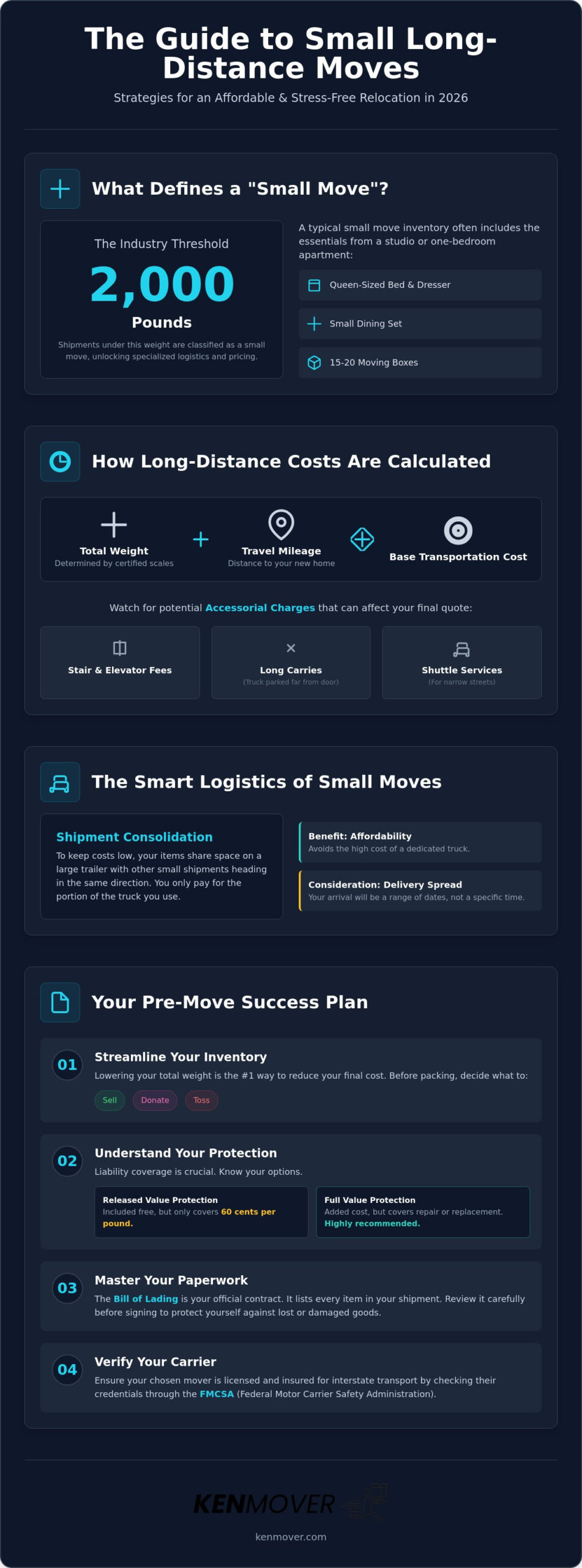
Preparation Checklist: Streamlining Your Small Interstate Move
Preparation is the bridge between a chaotic transition and a seamless arrival. When you are managing small moves long distance, every pound and every box counts toward your final budget and peace of mind. Unlike a local move where you might toss loose items into a car trunk, an interstate relocation requires your inventory to be “road-hardened” for hundreds of miles of transit. A disciplined approach to your checklist ensures that you only pay for what you truly need while protecting your belongings from the rigors of the highway.
Inventory Auditing for Cost Savings
Weight is the most significant variable in your moving quote. A rigorous audit using the “sell, donate, or toss” methodology is your best tool for price control. Reducing your total shipment weight by even 200 pounds can result in a noticeably lower final bill. Focus your transport budget on high-value, low-weight items that are difficult or expensive to replace. For heavy, low-value furniture, it is often more cost-effective to sell the item in the DFW area and buy new at your destination. You can support the local community by dropping off unwanted goods at DFW donation centers like the Tarrant County Goodwill or the Salvation Army Family Store in Fort Worth.
Packing for the Long Haul
Standard boxes from a grocery store aren’t designed for the sustained vibrations of a long-distance trailer. You should invest in high-quality, double-walled corrugated boxes to prevent crushing during transit. Fragile items require extra layers of defense to survive shifting loads. The box-in-a-box technique involves placing a smaller, cushioned item inside a larger box filled with at least two inches of padding on all sides to absorb road shocks. For electronics and specialty items, use original packaging whenever possible or wrap them in anti-static bubble wrap before securing them in a heavy-duty carton.
Labeling and Essentials
Because your belongings will likely share a trailer with other shipments, clear labeling is non-negotiable. Use bold, permanent markers to write your last name and destination city on at least three sides of every box. This simple step prevents your inventory from being mixed up during the consolidation process. Additionally, you must prepare a “First Night” bag. Since delivery windows for shared loads can span several days, this bag should contain your essential medications, chargers, basic toiletries, and two days of clothing. This ensures you can function comfortably in your new home while waiting for the truck to arrive.
Taking the time to pack correctly saves you from the heartbreak of damaged heirlooms. If you’re unsure about your ability to secure heavy furniture or fragile items, our packing and unpacking services provide the professional touch needed for a safe journey. We use industry-standard materials to ensure every item is road-ready before it leaves the DFW Metroplex.
Safe and Reliable Long-Distance Solutions with KenMover
KenMover bridges the gap between the personalized care of a local business and the complex logistics of national transport. We understand that small moves long distance require a partner who treats a few cherished heirlooms with the same respect as a full estate. We bring our deep-rooted Fort Worth values to every interstate project. By combining the neighborly touch of a local expert with the rigorous licensing required for out-of-state transport, we eliminate the anxiety often associated with massive van lines. You aren’t just another number in a consolidated trailer; you’re a client whose transition deserves our full attention.
Our service model is built on the pillars of transparency and disciplined flexibility. Whether you need a comprehensive Residential Moving Service or a professional crew to handle Loading, Unloading & Storage Pods you’ve already rented, we adapt to your specific strategy. We don’t believe in hidden fees or surprise surcharges. Instead, we provide clear, upfront pricing that respects your budget. This steady reliability ensures that your out-of-state move stays within the financial boundaries we establish during your initial consultation, allowing you to plan your new life without fiscal stress.
Why Euless and Southlake Residents Trust Us
Residents in Southlake and Euless often face unique logistical hurdles, from gated community restrictions to complex apartment layouts. Our teams possess intimate knowledge of North Texas neighborhoods and the specific regulations that govern local loading zones. This local expertise allows us to navigate the DFW Metroplex with a level of precision that national carriers simply can’t match. We maintain a “can-do” attitude, tackling difficult tasks like Heavy Furniture, Assembly & Disassembly with technical skill and a respectful touch. We specialize in sensitive transitions, including Senior Living & Assisted Relocation, where empathy is just as important as physical strength.
Booking Your Move with Confidence
Starting your journey with us is a straightforward, linear process. It begins with a detailed inventory assessment to ensure your quote is perfectly tailored to your small inventory. On moving day, our crew arrives on time and fully equipped with the specialized tools needed for items like pianos or safes. We handle the physical labor, the logistical routing, and the heavy lifting, allowing you to focus on your new destination. Our goal is to shift the burden of relocation from your shoulders to our experts. You can Request a long-distance moving quote from KenMover today to see how simple small moves long distance can be when you have the right team in your corner.
Your Next Chapter Starts with a Seamless Transition
Managing small moves long distance doesn’t have to be a source of anxiety. Success lies in understanding the 2,000-pound threshold and choosing a strategy that balances cost with physical safety. By auditing your inventory and selecting a partner who specializes in consolidated shipments, you avoid the high minimum weight requirements of national van lines. You’ve learned how to streamline your packing and protect your belongings against the rigors of interstate travel. Now, it’s time to put that plan into action with a team that values your transition as much as you do.
As a locally owned and operated Fort Worth business, KenMover provides the expertise of a licensed out-of-state relocation expert with the personal touch of a neighbor. We are specialists in senior and apartment moving, ensuring every item is handled with meticulous care. Whether you need full-service packing or labor support for a storage pod, we’re here to simplify your journey. Get a Stress-Free Quote for Your Small Long-Distance Move and let us handle the heavy lifting while you focus on your new home. Your cross-country move is a major milestone, and we’re ready to make it a success.
Frequently Asked Questions
Is there a minimum weight for long-distance moving?
Most national carriers enforce a minimum weight requirement, which often starts at 2,000 pounds for interstate transport. If your inventory falls below this limit, you’ll likely still pay the base price for that minimum weight. Choosing a specialist for small moves long distance helps you avoid paying for “empty air” by utilizing logistics models specifically designed for smaller shipments and partial loads.
How much does a small long-distance move cost on average?
While we provide personalized quotes based on specific needs, industry data for 2026 shows that moving a studio or one-bedroom apartment long distance typically costs between $1,200 and $4,200. Your final price is determined by the certified weight of your goods and the total mileage from the DFW area. Getting a tailored walkthrough is the only way to ensure your quote reflects your specific inventory and required services.
Will my items be on a truck with other people’s belongings?
Yes, consolidation is a standard industry practice where your items share space on a large trailer with other small shipments headed in the same direction. This method is highly efficient and keeps your costs down by splitting the transportation expenses among several clients. Each shipment is partitioned and inventoried separately on the Bill of Lading to prevent any mix-ups during the loading or unloading process.
How do I protect my furniture during a long-distance move?
Professional-grade padding and stretch wrap are your best defense against road vibration and shifting loads. Wrap every finished surface in thick moving blankets and secure them with tape, ensuring the tape never touches the furniture itself. For specialty items like pianos or heavy safes, professional handling is necessary to manage the weight and balance safely during the long trek across state lines.
Can I move just one piece of furniture across the country?
Moving a single item like a piano or a heavy safe is a standard service for specialized carriers. These pieces are often handled as part of a consolidated freight network, allowing them to travel safely without the need for a full moving crew. This is an ideal solution for sending heirlooms or high-value purchases to a different state without the expense of a full-scale relocation.
What is the fastest way to move a small apartment long distance?
Using a portable storage container or a small-load specialist is usually the quickest route for a small apartment. These services often bypass the longer consolidation times associated with massive van lines. While a shared trailer might have a delivery spread of several days, a containerized move often provides a more precise arrival date, which is essential for those on a tight professional or personal schedule.
Do I need insurance for a small long-distance move?
You should always have a form of liability coverage to protect your investment. The standard Released Value Protection is provided at no extra cost but only covers 60 cents per pound per item. For valuable electronics or delicate furniture, Full Value Protection is a safer choice because it covers the actual cost of repair or replacement if an unexpected accident happens during transit.
How far in advance should I book a small long-distance move?
Booking four to eight weeks before your desired date is the best way to secure a reliable timeline and competitive rate. The peak moving season between May and September fills up quickly, often leading to limited availability for specific routes. Early booking for small moves long distance allows for a more methodical preparation process and ensures you can secure your preferred delivery window with total confidence.